
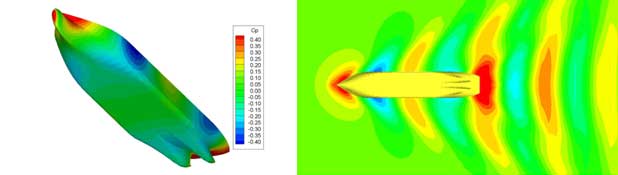
Computational Fluid Dynamics (CFD) analysis are preferred for problems like hull form optimization, ship resistance calculation, ship’s appendage resistance calculation, propulsion parameters study, propeller calculations, flow simulation around the superstructure or flow simulation in ventilation ducts. In Omeltd CFD analysis are carried out by using DeltaFlow and ANSYS Fluent software applications.
Omeltd is an in-house developed software and runs according to Dawson algorithm and solves the potential flow around the ship by considering the free surface effect. DeltaFlow can be used for monohull, catamaran and trimaran forms. Essentially the software is a useful tool for optimization of hull form in terms of wave resistance and determination of the wave resistance level. The additional information taken as a result of the analysis are used also to improve the hull form from the form resistance point of view. The result that can be obtained by using DeltaFlow are cited below,
- Wave deformations around the ship and at free surface level
- Dynamic pressure distribution on the ship
- Streamlines
- Wave resistance
ANSYS Fluent software application is able to solve different turbulence models and viscous flow problems. Omeltd, by using DeltaFlow application, provides solutions to various fluid based engineering problems such as hull form optimization. By this method, variables like ship’s speed, the necessary power to achieve the required speed and the necessary fuel amount to get the needed power can be calculated and optimized in most economic and environment-friendly way. Omeltd provides to its customer following engineering analysis services within the scope of a ship design project.
- Ship friction, form and wave resistance calculation
- Appendage resistance calculation
- Wake distribution on propeller plane
- Free surface flow and friction resistance
- Underwater and surface flow stream plots
- Calculation of propeller’s kt, kq and cavitation
- Propulsion test and calculation of propulsion parameters (effective wake, thrust deduction, relative rotative efficiency) with propeller
- Effect of the propeller on ship’s hull and noise induced by propeller
- Flow in ventilation ducts and ventilation simulation
- Calculation of hydrodynamic derivatives for maneuvering calculations